Hi friends,
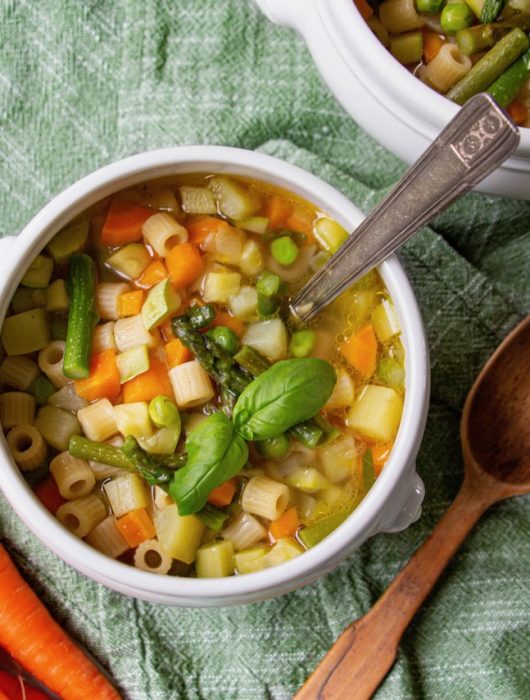
This year, the nice days are really struggling to settle in. It’s hard to envision a kitchen filled with salads and other raw vegetables… Thankfully, I have the perfect solution to this dilemma with my spring minestrone.

A recipe that completes the picture
I already have two recipes in the same spirit that you will also enjoy:
- my pistou soup (or summer minestrone, actually)
- and the soup pasta e fagioli, Casserole & Chocolat style.
These two preparations are very indulgent and are bursting with seasonal vegetables. Here, with my spring minestrone, we will stay within the same style of recipe, featuring a good dose of spring produce. You will love it!
What is minestrone?
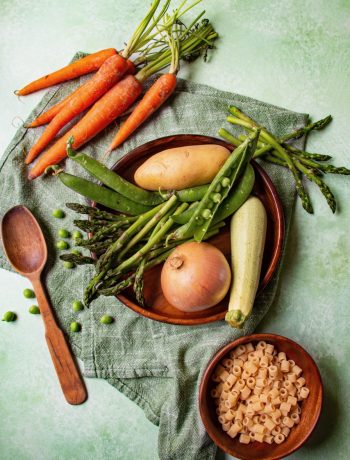
Minestrone (meaning « vegetable soup » in Italian, from minestra) is a rich vegetable soup from Italian cuisine, often enriched with pasta or rice and served with grated Parmigiano Reggiano. The culinary author Angelo Pellegrini noted that the base of minestrone is a bean broth and that borlotti beans (also known as Roman beans) « are the beans to use for the true minestrone ». The minestrone is a dish that varies by region and season, leading to countless adaptations, which is something I particularly appreciate. This allows us to tailor the recipe according to the season and what we have on hand—a true « Swiss army knife » of recipes! 😉
The classic ingredients of this soup
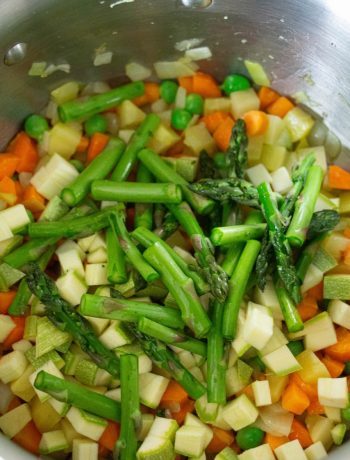
The ingredients, preparation methods, consistency, and even the way it’s served can greatly vary based on local traditions. A particularly famous variation is Genoese minestrone, which includes a spoonful of pesto added just before serving. (See my pesto sauce here).
Traditionally, minestrone was made with whatever seasonal vegetables were on hand, allowing for the use of even those that weren’t very fresh, especially those hard to digest without lengthy cooking. This is why it was regarded as a quintessential peasant dish, typical of Italian countryside cooking. Over time, with changing economic conditions and eating habits, it has gained appreciation across various social circles and is sometimes even featured in upscale restaurants.
(Source Wikipedia)
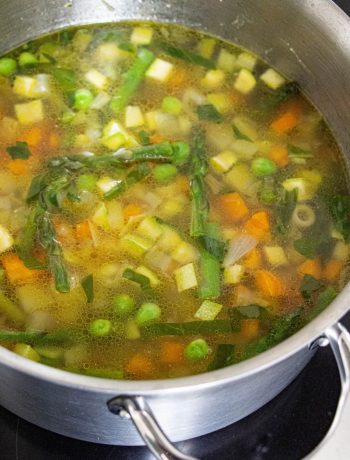
A simple and flavorful recipe
As you can see, minestrone can be enjoyed in any season, so my spring minestrone is quite timely!
Its preparation is very straightforward, and the cooking process is quicker compared to the first two soups mentioned earlier. For vegetables, you’ll find green asparagus, zucchini, and of course, fresh peas. I strongly recommend using fresh peas: canned peas will not work at all for this recipe, though frozen peas are a fine alternative.
I’ve chosen Tubetti Rigati pasta from the Rummo brand to enhance my minestrone; Barilla’s Ditali would also work wonderfully.
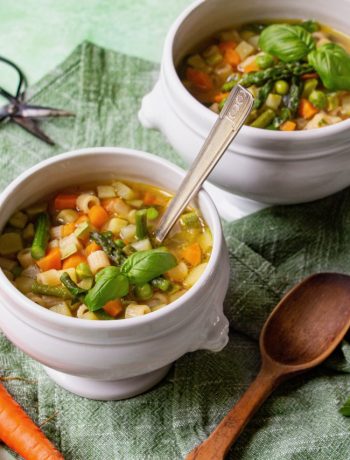
The spring minestrone has all the appeal
This recipe fits into two categories:
waste-free recipes, as we can use leftovers from the fridge and add a bit of everything
batch cooking recipes, since we can prepare a good amount to reheat throughout the week. The leftover vegetables can also be used for a vegetable cake, for example!
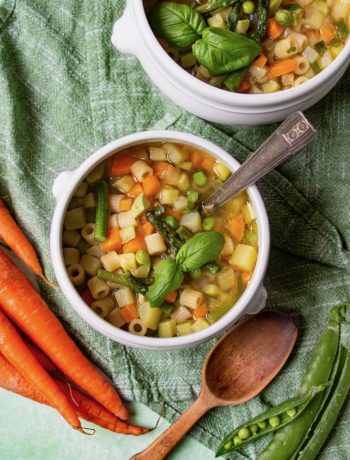
The necessary utensils:
A cutting board,
One good knife (I use my Zwilling universal knife which is just perfect),
A peeler,
One large pot,
A small frying pan
And one other pot for the pasta.
There you go, you probably have all that on hand!
Other ideas just for you
If you love this spring minestrone, I’m sure you’ll also enjoy other sunny recipes that I love to prepare as soon as the first rays appear. To keep with the comforting Italian theme, you can try Tuscan White Bean Soup or Ribollita, a rustic and ultra-gourmet dish.
When I crave tender and flavorful vegetables, I often turn to Frittata with Sun Vegetables or Roasted Fennel with Tomato Oil and Labneh. These two recipes are perfect for a light dinner that’s still packed with flavor.
And for a more playful meal, almost like a dinner party appetizer, I love to serve my Zucchini and Olive Spaghetti. Pair it with a delicious stir-fry of Shakshuka, and you’re sure to impress your guests.
Create a true spring buffet that is colorful, friendly, and above all, delicious!
Shall we put on our aprons to make my spring minestrone?
The recipe, Chef!
Spring Minestrone
 ( Vote !)
 Loading...
Ingredients
- 150 g of small pasta
- 50 g of peas
- 1/2 onion
- 1 clove of garlic
- 2 tablespoons of olive oil
- 3 carrots
- 1 potato
- 1 zucchini
- 4-6 basil leaves
- 1 bouillon cube
- 1 l of water
- Salt
- Pepper
- 50 g of asparagus tips
- 1 tablespoon of olive oil
Instructions
Bring salted water to a boil in a saucepan, add the pasta as soon as it reaches a boil, and cook for 2 minutes less than the package instructions. Drain and set aside.
Bring salted water to a boil in a small saucepan, add the peas as soon as it reaches a boil, and cook for 8 minutes. Drain and set aside.
Sauté the chopped onion and grated garlic with olive oil in your large saucepan.
Add the peeled and diced carrots and potatoes.
Then add the zucchini, also diced, and sauté for 2 minutes.
Add the water, the bouillon cube, the peas, the chopped basil leaves, salt, and pepper, and bring to a boil.
As soon as the first bubbles appear, reduce to low heat and cover.
Cook for 20 minutes.
Heat the tablespoon of olive oil in a small frying pan. Add the asparagus tips and cook over medium heat for 2 minutes.
Add to the soup.
At the end of cooking, add the pasta and adjust the seasoning.
Cook for another 2-3 minutes and serve!
No Comments