
Hello foodies,
Today, we’re in for a real treat! We’re going to delve into some delectable pastries, but with a simplified twist. Let me guide you through it!
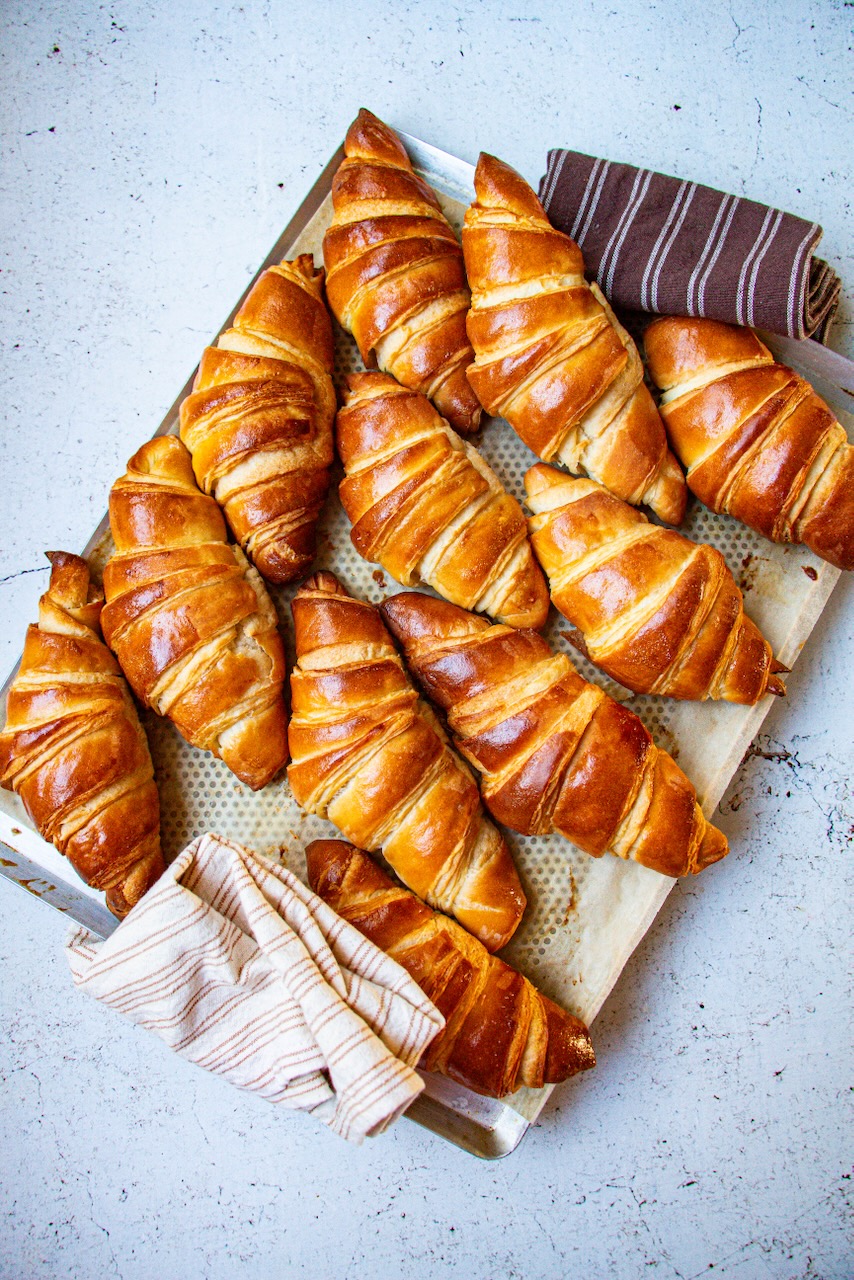
Here are my croissants inspired by Cédric Grolet.
Why Cédric Grolet-style croissants?
Let me clarify what I mean by « style. »
You may already know that I have Cédric Grolet’s pain au chocolat recipe on the blog. This recipe is true to the one found in his book « Opéra, » but I’ve added detailed explanations to ensure it’s accessible for everyone.
This pain au chocolat recipe can easily be adapted into croissants. However, there are a couple of challenges. 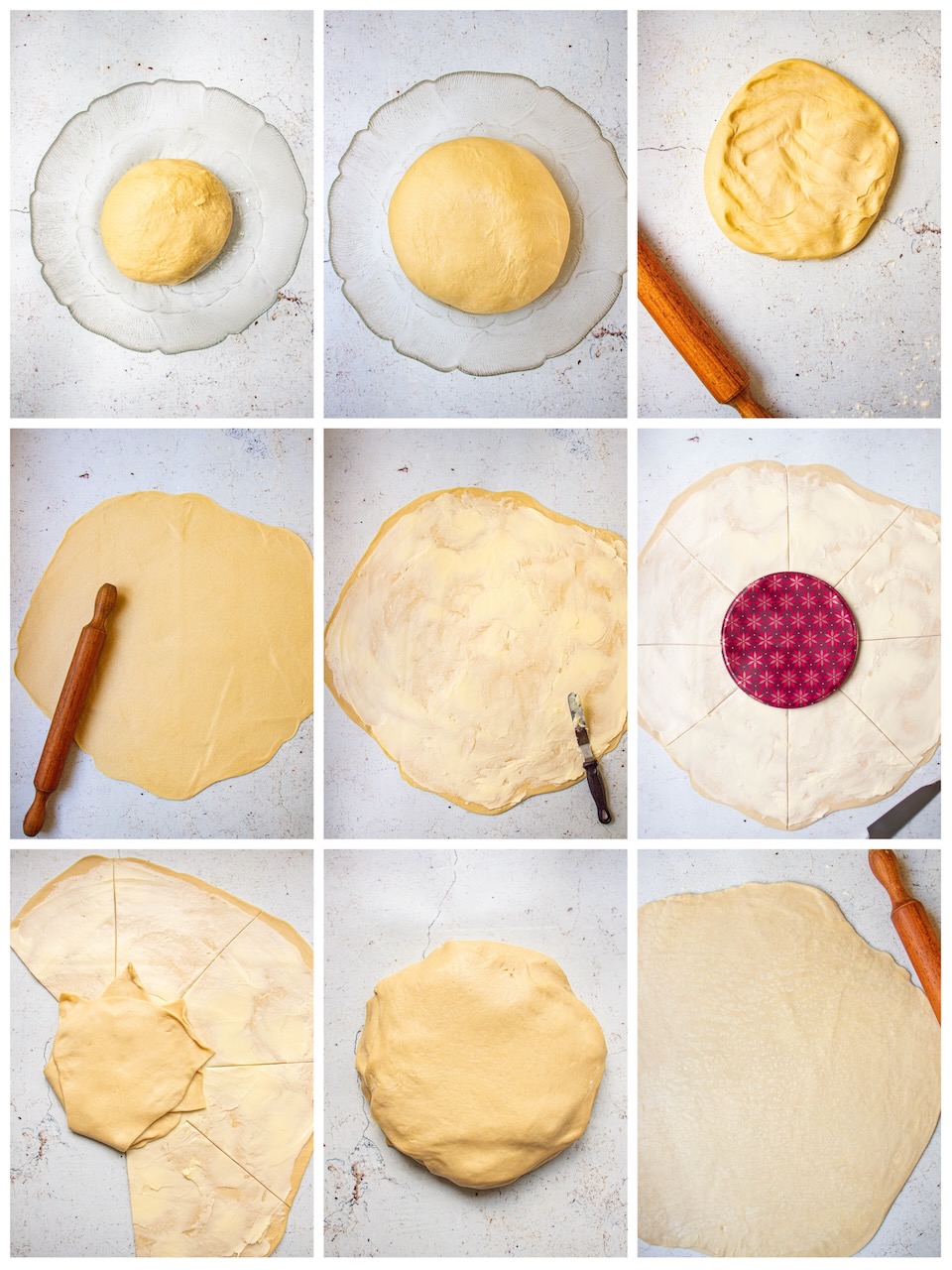 Firstly, making puff pastry can be time-consuming and sometimes tricky when using a brioche dough base. But fear not! I’m going to share a fantastic tip that will make shaping as easy as pie!
Secondly, shaping pain au chocolat is straightforward—you roll out the dough into a rectangle and cut out smaller rectangles. For croissants, on the other hand, you need to create triangles, which can lead to leftover scraps of dough. I’m not a fan of waste, and with the method I’ll be proposing today, we’ll eliminate that!
So, you can see I’m taking Cédric Grolet’s recipe and making just a couple of minor adjustments!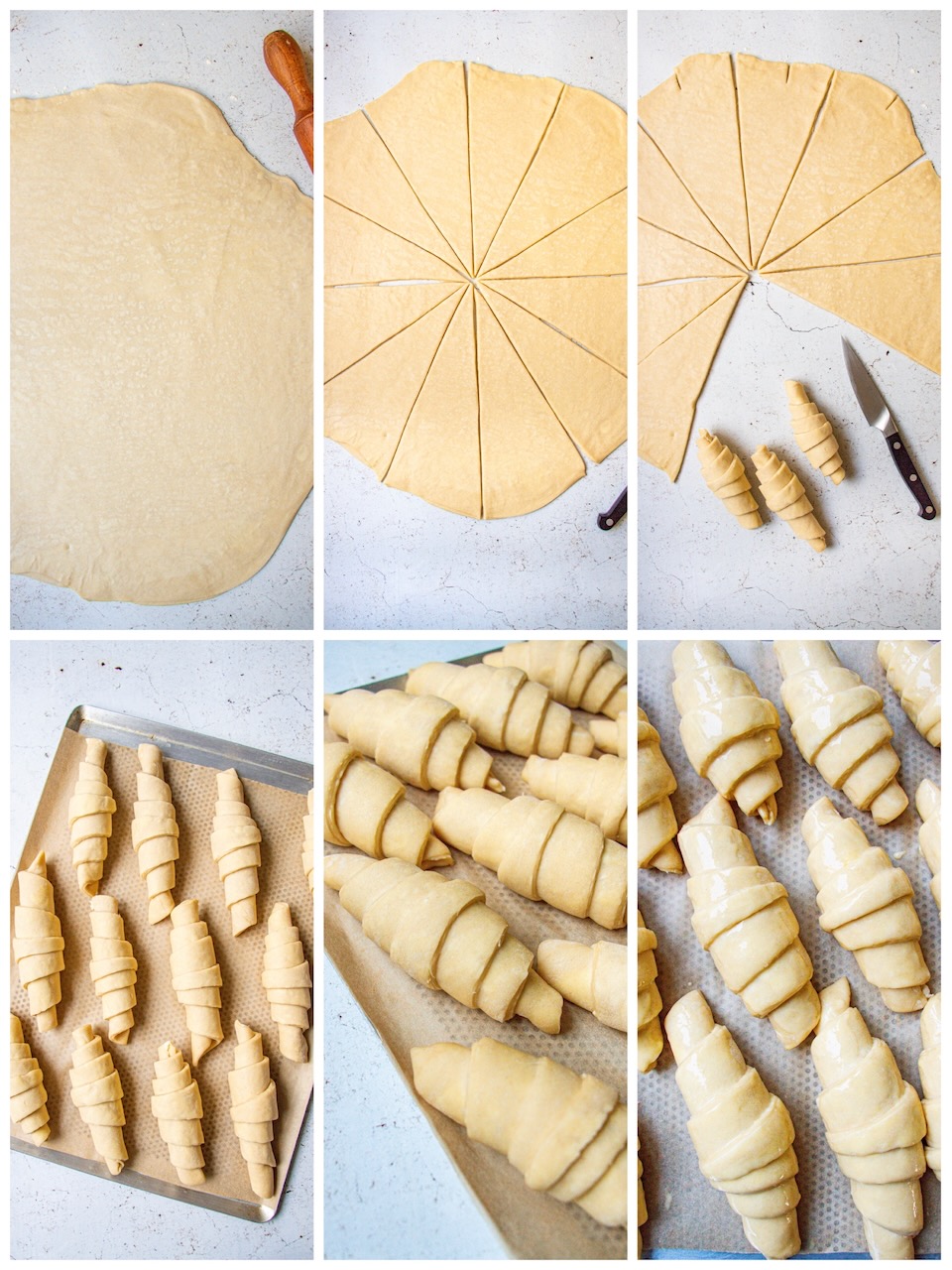
My version of croissants in the style of Cédric Grolet
First point: How do we resolve the shaping issue?
We’ll simply roll out the brioche dough on a large surface until it’s nice and thin.
Instead of adding a square of butter, we will « spread » softened butter across the entire surface. Then, we’ll make cuts to fold the dough over the center in successive layers. In the end, we’ll have nine layers of dough, each spread with butter. That’s our secret to perfect layering!
Second point: How to avoid dough waste?
Once the layering is complete, we’ll roll out the dough into a sufficiently large circle. Then we’ll cut out triangles from the center of the disk. This way, there’s no dough waste!
There you have it—my little tips shared with you. Sound good? 
Is the origin of the croissant French?
I was surprised by what I discovered while researching for this article…
While the croissant is often seen as one of the most iconic symbols of French baking, its history is more complex and older than one might think. Contrary to popular belief, the croissant did not originate directly in France—it has deeper roots in Central Europe. Can you believe it?!
Its most frequently mentioned ancestor is the kipferl, a crescent-shaped pastry that has been enjoyed in Austria since the Middle Ages. Several legends surround its popularity, particularly one connected to the 17th-century siege of Vienna, where bakers supposedly created a crescent-shaped pastry to celebrate victory over the Ottoman Empire. While this story is compelling, its historical accuracy is hard to confirm.
In the 19th century, France adopted and transformed this pastry. Introduced in Paris by Austrian bakers, the kipferl was then refined with French techniques, notably the use of buttery puff pastry. This evolution led to the croissant as we know it today: light, crispy on the outside, and meltingly tender on the inside.
Thus, the croissant represents a delightful blend of Viennese tradition and French expertise. Now an essential part of breakfast, it embodies the elegance and craftsmanship of French baking around the world, defining the very essence of viennoiserie… 😉
Storing your Cédric Grolet-style croissants
Let’s be honest; croissants are best enjoyed fresh! Allow them to cool after taking them out of the oven. When they’re warm, that’s when I truly can’t resist!
Beyond the day of baking, you have two options. You can freeze them. In this case, let them thaw at room temperature and pop them in the oven for 2 minutes at 300°F (150°C) to restore some freshness. Alternatively, if you consume them the next day, give them a brief time in the oven.
You can also freeze your uncooked croissants after shaping—just allow them to thaw and proof before baking, and then glaze them.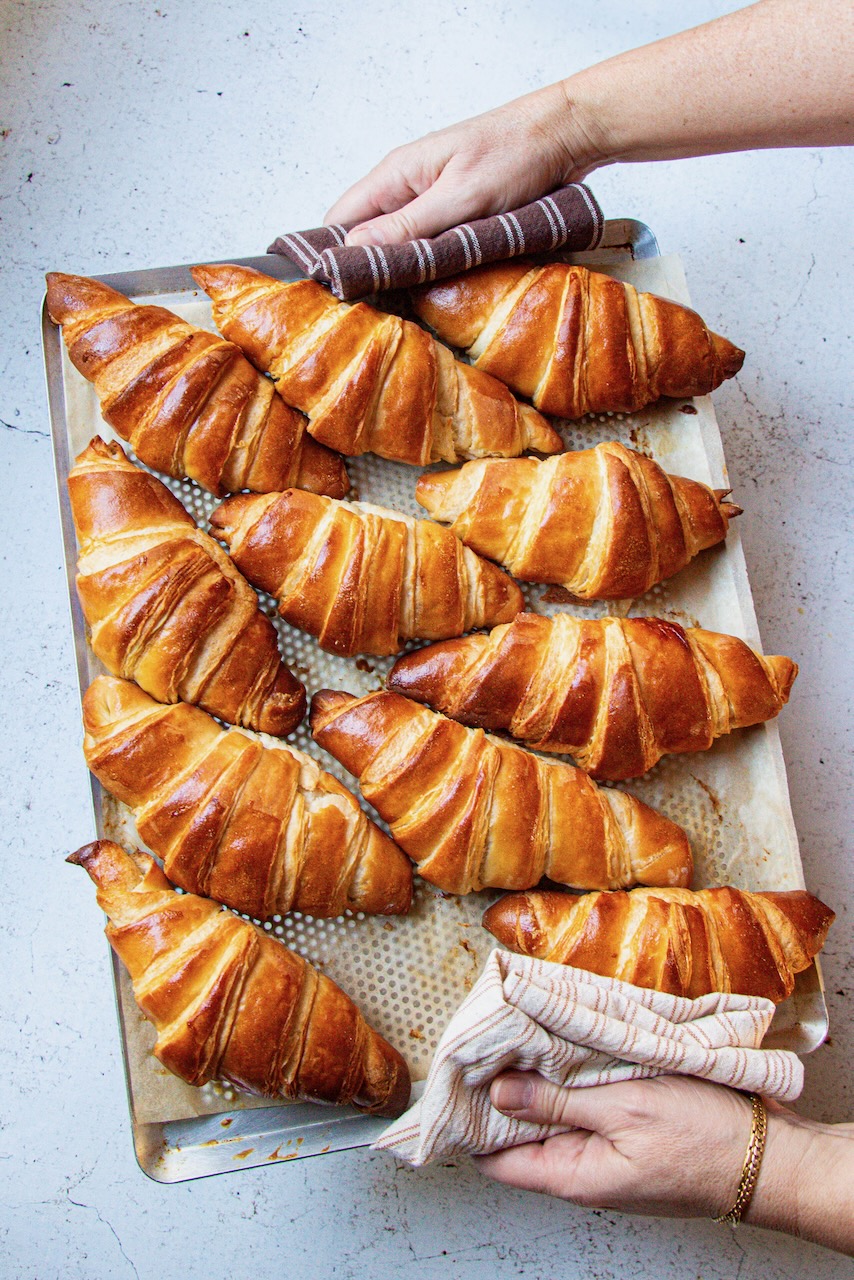
The necessary utensils:
A stand mixer with a dough hook,
A rolling pin,
One small offset spatula,
A sharp paring knife,
A pastry brush,
And two baking mats (or sheets lined with parchment paper). Now, I’ve shared everything you need to know! All that’s left is for you to head to the kitchen, roll up your sleeves, and make delicious croissants like Cédric Grolet!
Other ideas just for you
And if you love working with dough as much as I do, you should definitely check out more ultra-gourmet recipes on the blog.
To keep the comforting baking vibes going, I recommend trying The Brioche Babka (by Jeffrey Cagnes), featuring utterly irresistible chocolate marbling. For a more traditional option, The Kouglof from my place is perfect for a Sunday snack—soft and fragrant, just like in Alsace.
If you’re after a super airy crumb, look no further than The Mousseline Brioche, a fluffy delight that’s perfect for breakfast. And for puff pastry enthusiasts, Layered Brioche will enchant you with its buttery layers. To stay connected to Cédric Grolet’s universe without recreating these croissants, I invite you to discover Cédric Grolet’s Sugar Pie, a simple yet generous treat that never fails to impress.The recipe, Chef!
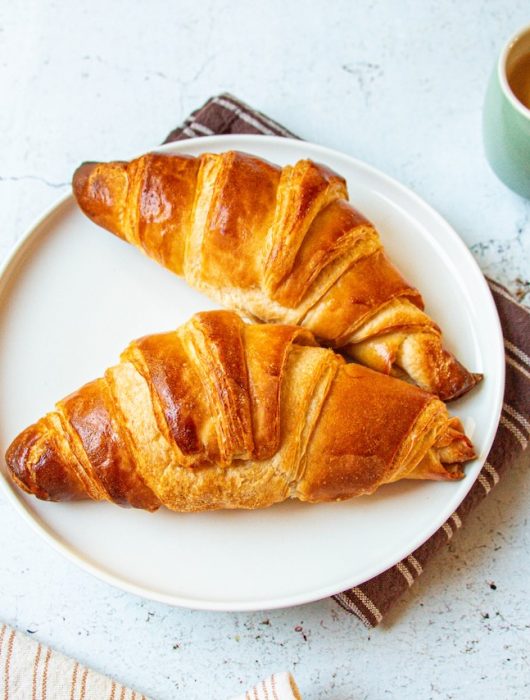
Cédric Grolet-style croissants
 ( Vote !)
  Loading...
Ingredients
- Croissant Dough
- 500 g of flour
- 25 g of beaten egg
- 50 g of sugar
- 9 g of salt
- 10 g of honey
- 210 g of water
- 10 g of dehydrated baker's yeast
- 35 g of soft butter
- 200 g of soft butter
- Finishing
- 1/2 tablespoon of cream
- 1 pinch of salt
Instructions
Put the flour, the 25 g of egg, the sugar, the salt, and the honey in the bowl of the mixer.
Mix the yeast with the lukewarm water.
Start kneading at low speed and pour in the water in a thin stream.
When the mixture is homogeneous, increase the speed of the mixer slightly.
When the dough pulls away from the sides of the bowl, add the 35 g of soft butter.
Knead until you have a smooth and supple dough.
Cover with a damp cloth and let rise for an hour.
After the rise, work the dough by hand and roll it out with your rolling pin until you have a disk approximately 70 cm in diameter.
Spread the 200 g of butter over the entire surface.
Place a 22 cm plate upside down in the center of the dough. Make 8 cuts to create 8 pieces of dough of equal size.
Remove the plate and fold the first piece over the center.
Then fold the other pieces, stacking them neatly on top of each other.
Set the dough aside in the refrigerator for a good 20 minutes.
Roll out the dough until you have a disk about 3.5 mm thick.
Finishing
Using a sharp knife, start from the center and cut to make 12 triangles.
Make a small cut in the middle of the base of your triangles and roll your croissants starting from the base toward the tip of the triangle.
Place your 12 croissants on two baking trays lined with parchment paper, spacing them well apart.
Let rise for about 1 hour.
After this time, preheat your oven to 190 degrees.
Mix the remaining beaten egg (the one used for the dough) with the cream and the salt.
Brush your croissants without applying any glaze on the edges.
Bake for about 20 minutes.
No Comments